How to Integrate Your Sales Methodology into Daily Workflows (CRM, Calls, Deals)

How to Integrate Your Sales Methodology into Daily Workflows
Your team passed the MEDDIC certification. They aced the role plays. Everyone was enthusiastic.
Six weeks later, you're in a pipeline review asking "who's the economic buyer on this deal?" and getting blank stares. The CRM fields are empty or filled with guesses. Your forecast is as unreliable as it was before the training.
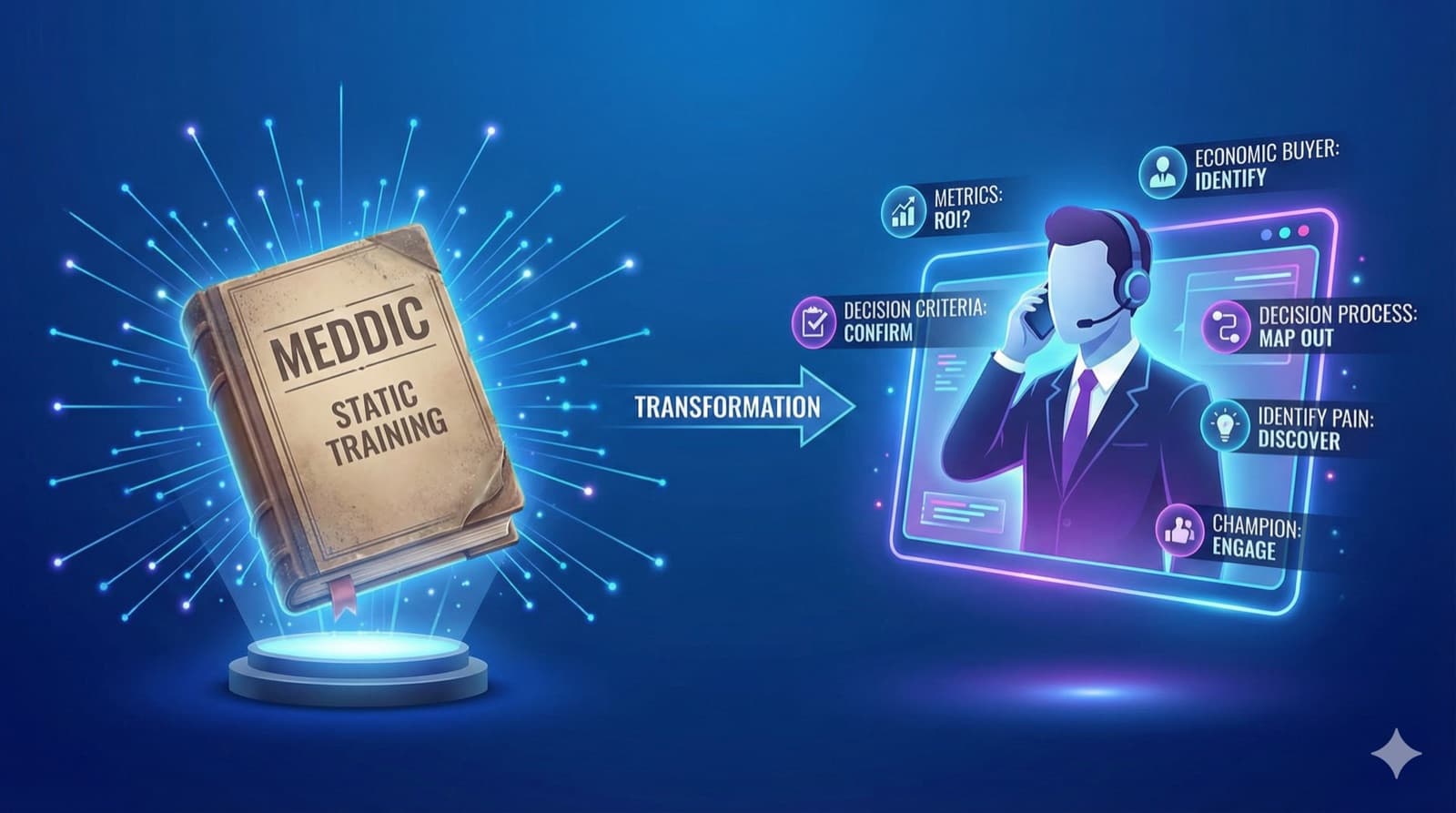
This happens to almost everyone who implements a sales methodology. The training itself isn't the problem—it's that methodologies live in a training deck while selling happens in CRM, calls, and calendar invites. Until those two worlds connect, nothing changes.
The Gap Between Knowing and Doing
Here's what typically happens after methodology training:
| What Training Teaches | What Happens in Practice |
|---|---|
| Ask about Economic Buyer early | Rep forgets in the flow of conversation |
| Document Decision Process | Rep guesses when updating CRM after the call |
| Identify Champion | Rep assumes their main contact is the Champion |
| Quantify Metrics | Rep accepts vague "improvement" answers |
Research on training retention consistently shows that most information is forgotten within days without reinforcement. The exact numbers vary by study (and frankly, some of the commonly cited statistics are hard to verify), but the pattern is clear: one-time training doesn't stick.
The CRM Compliance Trap
Most organizations try to solve this with CRM fields:
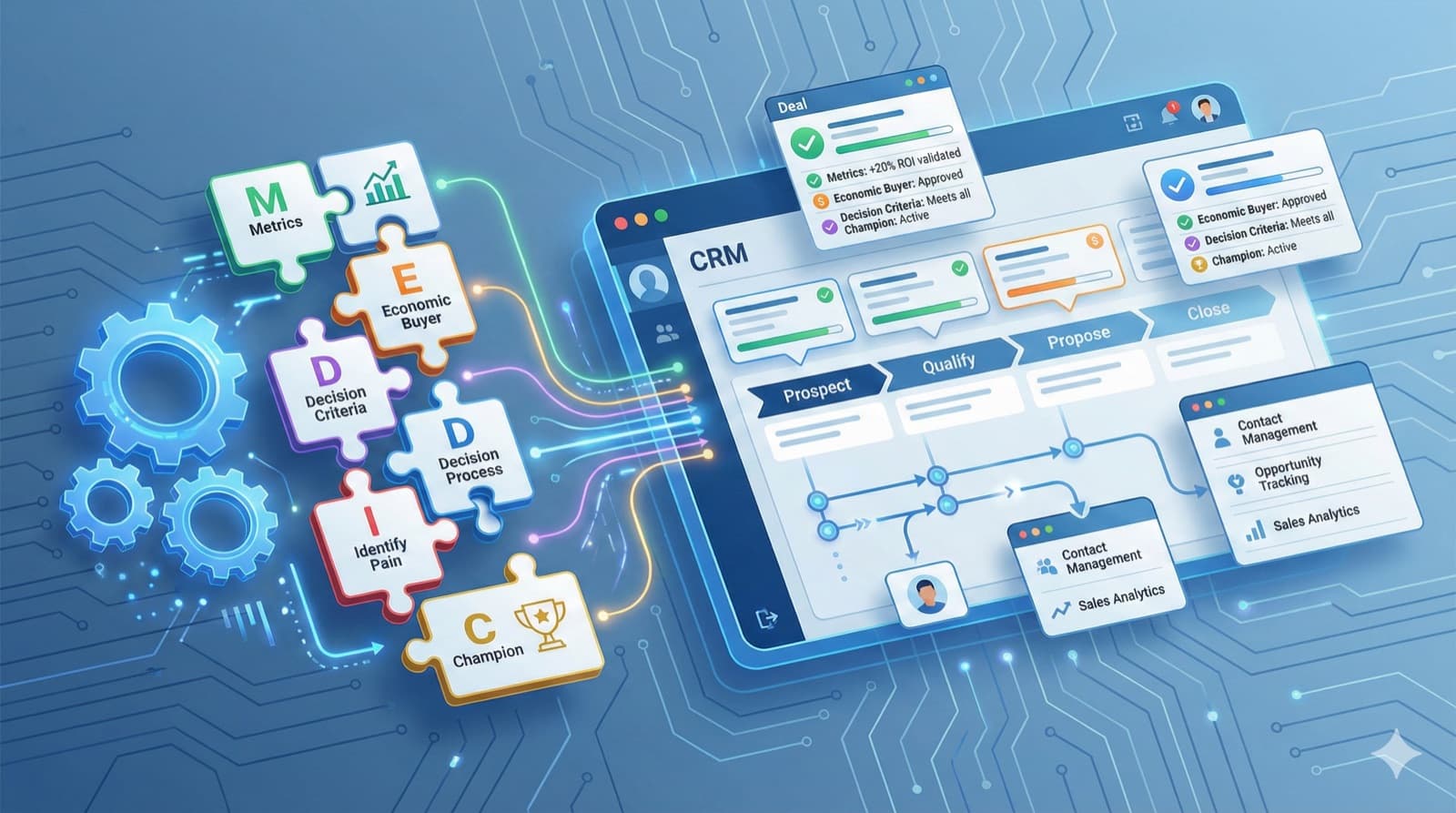
- Add MEDDIC fields to opportunity records
- Require completion before stage advancement
- Review in pipeline meetings
The result:
- Fields get back-filled from memory (inaccurately)
- Reps treat it as admin, not selling tool
- Data entered doesn't reflect reality
- Managers can't trust what they see
The Timing Problem
Pipeline reviews catch methodology gaps days or weeks after the conversation where the information should have been gathered.
By then, it's too late. You can't go back to a discovery call and ask about Decision Process. The moment has passed.
A More Practical Approach
Rather than fighting the timing problem, work with it. Methodology integration needs to happen at three points—and honestly, most companies only nail one of these, which is why results are inconsistent:
| Point | Goal | Method |
|---|---|---|
| Before the call | Prepare rep to execute methodology | Meeting prep that highlights gaps |
| During the call | Guide rep in the moment | Real-time prompts and questions |
| After the call | Capture what was learned | Auto-capture and structured review |
Part 1: CRM Configuration (The Foundation)
Designing Methodology Fields
Wrong approach: Create text fields for each MEDDIC element
- Economic Buyer: [free text]
- Decision Criteria: [free text]
- Results: Too much friction, inconsistent data
Right approach: Use structured fields that guide and validate
Economic Buyer Field
| Field Type | Options |
|---|---|
| Picklist: EB Identified? | Not Yet / Identified / Engaged / Aligned |
| Lookup: Economic Buyer | Contact record |
| Text: EB Access Strategy | How to reach/influence them |
Decision Criteria Field
| Field Type | Options |
|---|---|
| Multi-select: Known Criteria | Technical Fit / Price / ROI / Vendor Stability / etc. |
| Picklist: Our Position | Strong / Competitive / Weak / Unknown |
| Text: Criteria Notes | Specifics for this deal |
Champion Field
| Field Type | Options |
|---|---|
| Lookup: Champion Candidate | Contact record |
| Picklist: Champion Status | Suspected / Tested / Confirmed / No Champion |
| Text: Champion Evidence | What have they done to prove advocacy? |
Stage-Gating with Methodology
Configure CRM so opportunities can't advance without methodology completion:
Example: Discovery → Evaluation
Required before advancement:
- Pain identified and documented
- At least 2 stakeholders mapped
- Decision timeline captured
- Champion candidate identified
Example: Evaluation → Negotiation
Required before advancement:
- Economic Buyer identified AND engaged
- Decision Criteria documented
- Decision Process mapped
- Metrics quantified
Salesforce-Specific Implementation
// Validation rule example for MEDDIC stage gate
AND(
  ISPICKVAL(StageName, "Negotiation"),
  OR(
    ISBLANK(Economic_Buyer__c),
    ISPICKVAL(EB_Status__c, "Not Yet"),
    ISBLANK(Decision_Process__c)
  )
)

Error: "Cannot advance to Negotiation without Economic Buyer engaged and Decision Process documented."
HubSpot-Specific Implementation
Use required properties on deal stages:
- Create custom properties for each methodology element
- Configure stage progression rules
- Set up workflow to alert when gaps exist
Part 2: Pre-Call Integration
Meeting Prep That Highlights Gaps
Before every call, reps should see:
For Discovery Calls:
- "You haven't identified Pain for this account yet. Focus questions on..."
- "No stakeholders beyond your main contact. Ask about who else is involved..."
- "Competitor mentioned in notes. Prepare positioning for..."
For Demo Calls:
- "Decision Criteria not yet documented. Open by confirming what they're evaluating..."
- "No Metrics captured. Tie demo outcomes to quantifiable results..."
For Late-Stage Calls:
- "Economic Buyer not yet engaged. Strategy to reach them..."
- "Decision Process has gaps. Confirm steps between now and signature..."
Automation Options
Manual process (baseline):
- Rep opens opportunity before meeting
- Checklist of methodology elements with completion status
- Gap guidance displayed
Semi-automated:
- Calendar integration triggers prep email
- Email includes opportunity gaps and suggested focus areas
- Links to relevant content
Fully automated:
- AI generates meeting brief
- Brief includes methodology gaps automatically
- Contextual questions and talk tracks provided
Meeting Prep Template
| Section | Content |
|---|---|
| Deal Overview | Stage, size, close date, key contacts |
| Methodology Status | Visual indicator for each element (complete/partial/missing) |
| Today's Objectives | What to accomplish in this meeting |
| Gap Focus | Top 2-3 methodology gaps to address |
| Questions to Ask | Specific questions for missing elements |
| Content to Use | Relevant case studies, ROI tools, etc. |
Part 3: Real-Time Integration
Live Methodology Prompts
The biggest opportunity—and challenge—is guiding reps during live conversations.
Traditional approach: Rep tries to remember methodology while listening, thinking, and responding. Result: Methodology is forgotten.
Integrated approach: System prompts methodology questions based on conversation context.
What Real-Time Integration Looks Like
Scenario: Discovery call with VP of Sales
Rep asks about current challenges...
System prompt: "Good pain identification. Follow up: What's the cost of this problem? (Metrics)"
Customer mentions they've looked at Competitor X...
System prompt: "Competitor mentioned. Ask: What did you like/not like about their approach?"
Call is ending without discussing timeline...
System prompt: "Decision Process gap: Ask about their evaluation timeline and approval process."
Technology Options
Low-tech: Pre-call checklist
- Printed or on-screen list of methodology questions
- Rep checks off as addressed
- Manual but better than nothing
Medium-tech: Note-taking template
- Structured note template in CRM
- Sections for each methodology element
- Forces documentation during call
High-tech: AI-powered prompts
- Real-time conversation analysis
- Contextual prompts based on discussion
- Automatic capture of responses
Implementation Considerations
Real-time prompts must be:
- Non-intrusive: Don't distract from the conversation
- Contextual: Relevant to what's being discussed
- Actionable: Specific questions, not vague reminders
- Optional: Rep can dismiss if not appropriate
Part 4: Post-Call Integration
Capturing What Was Learned
After every call, methodology information should flow into CRM:
Traditional:
- Rep tries to remember key points
- Opens CRM, scrolls to find fields
- Types abbreviated answers
- Accuracy: Low
Integrated:
- Call transcript analyzed
- Methodology elements auto-extracted
- Rep confirms/edits suggested entries
- Accuracy: High
Post-Call Workflow
| Step | Action | Time |
|---|---|---|
| 1 | Call ends, system prompts for quick notes | 0-5 min |
| 2 | AI suggests MEDDIC entries from conversation | Auto |
| 3 | Rep reviews and confirms/edits | 2-3 min |
| 4 | Entries saved to CRM | Auto |
| 5 | Gap analysis for next call | Auto |
Auto-Capture Technology
Modern AI can extract methodology elements from call transcripts:
From transcript: "Yeah, ultimately the CFO will need to sign off on anything over $50K. She's pretty focused on ROI—we'd need to show a clear payback within 12 months."
Auto-extracted:
- Economic Buyer: CFO (inferred)
- Decision Criteria: ROI, 12-month payback
- Metrics hint: $50K threshold
Scoring Deals Against Methodology
After each call, automatically score the opportunity:
| Element | Score |
|---|---|
| Metrics | 🟢 Quantified |
| Economic Buyer | 🟡 Identified, not engaged |
| Decision Criteria | 🟢 Documented |
| Decision Process | 🔴 Unknown |
| Identify Pain | 🟢 Clear and urgent |
| Champion | 🟡 Suspected, not tested |
Overall Score: 67/100
This score informs forecasting, prioritization, and coaching focus.
Part 5: Review Integration
Pipeline Reviews That Work
Traditional pipeline review:
- Manager asks about deals
- Rep reads MEDDIC fields
- No one knows if data is accurate
- Same gaps appear week after week
Methodology-integrated review:
- System shows methodology scores
- Flagged gaps drive discussion
- Specific action items for each gap
- Progress tracked over time
Review Agenda Template
| Time | Topic | Focus |
|---|---|---|
| 5 min | Score review | Which deals have lowest methodology scores? |
| 10 min | Gap deep-dive | Pick 2-3 deals with critical gaps |
| 10 min | Action planning | What will rep do to close gaps? |
| 5 min | Pattern review | Are there recurring gaps across deals? |
Coaching Focus Areas
| Gap Pattern | Coaching Focus |
|---|---|
| Consistently missing Economic Buyer | Role-play asking about budget authority |
| Weak Champion identification | Discuss Champion testing techniques |
| No quantified Metrics | Practice ROI conversation |
| Unknown Decision Process | Provide mapping questions |
Measuring Integration Success
Leading Indicators
| Metric | Target | Indicates |
|---|---|---|
| Methodology completion rate | 80%+ | Process compliance |
| Time to complete (post-call) | <5 min | Workflow efficiency |
| Data accuracy (spot-check) | 90%+ | Quality of integration |
| Rep satisfaction | 4+/5 | Sustainable process |
Lagging Indicators
| Metric | Target | Indicates |
|---|---|---|
| Forecast accuracy | ±10% | Methodology predicting outcomes |
| Win rate improvement | +5-10% | Better deal execution |
| Sales cycle length | -10-15% | More efficient qualification |
| Deal slip rate | -20%+ | Earlier gap identification |
The Ultimate Test
Before integration:
- Manager: "Tell me about the Economic Buyer on the Acme deal."
- Rep: Scrolls through notes, guesses based on job titles
After integration:
- Manager: "Tell me about the Economic Buyer on the Acme deal."
- Rep: "It's the CFO, Jane. I engaged her last week. She's focused on ROI within 12 months. Here's the recorded conversation where she confirmed her role in the decision."
Implementation Roadmap
Week 1: CRM Foundation
- Audit current CRM fields
- Design structured methodology fields
- Configure stage-gating rules
- Test with pilot users
Week 2: Pre-Call Integration
- Create meeting prep template
- Configure calendar integration
- Build gap identification logic
- Train reps on new prep process
Week 3: Post-Call Integration
- Set up call logging workflow
- Configure auto-capture (if using)
- Create post-call prompt flow
- Define scoring algorithm
Week 4: Review Integration
- Update pipeline review process
- Create methodology dashboards
- Train managers on new review format
- Establish coaching cadence
Ongoing
- Monitor adoption metrics weekly
- Gather rep feedback
- Iterate on friction points
- Expand to additional teams
Common Pitfalls
1. Adding Friction Without Value
Symptom: Reps hate the new process, adoption crashes Solution: Every new field/step must directly help selling, not just reporting
2. Technology Without Process
Symptom: Tools implemented, but nobody uses them Solution: Change management before/alongside technology
3. Manager Non-Adoption
Symptom: Reps use it, managers ignore it in reviews Solution: Train managers first, make methodology part of review rhythm
4. Perfect Data Over Any Data
Symptom: Fields so complex that completion crashes Solution: Start simple, iterate to complexity
5. No Feedback Loop
Symptom: Same gaps appear quarter after quarter Solution: Regular retrospectives on methodology execution
What Actually Changes
We should be honest: full methodology integration is hard. Most organizations get partially there. Even partial integration—say, good pre-call prep with mediocre capture—is better than methodology as pure training exercise.
The biggest shift isn't technical. It's mindset: treating methodology as something that happens in the workflow rather than something reps are supposed to remember while simultaneously listening, thinking, and responding to customers.
If you only do one thing, focus on pre-call prep that explicitly shows methodology gaps. It's the lowest friction intervention with the highest impact—reps are already preparing for calls, and surfacing "you don't know who the Economic Buyer is" at that moment is more effective than asking about it in a pipeline review three days later.
RevWiser embeds sales methodologies into the deal workflow with real-time prompts and automatic capture. If you're struggling with the training-to-execution gap, see how it works.
RevWiser Team
Content writer at RevWiser, focusing on go-to-market strategies and sales enablement.