GTM Intelligence vs. Sales Enablement: Why Your Team Needs an Action-First Platform

Most sales technology categories solve part of the problem. Sales Enablement stores content. Revenue Intelligence analyzes calls. Conversation Intelligence transcribes meetings. Sales Engagement sequences emails.
None of them help reps sell better in the moment—when they're on a call with a skeptical CFO who just asked a question they weren't prepared for.
We believe that's the gap worth closing. GTM Intelligence is our attempt to describe what comes next: platforms that don't just inform reps, but guide them toward action. Whether the category name sticks matters less than whether the approach—proactive, contextual, action-oriented—becomes the norm.
Where Sales Technology Has Been
Sales Enablement: The Content Library Era
The first wave of sales enablement solved a real problem: sales teams couldn't find marketing content. Companies like Highspot, Seismic, and Showpad built repositories where marketing could upload collateral and sales could search for it.
The approach made sense in theory. In practice, it created new problems.
Content libraries tend to accumulate rather than curate. We've talked to enablement teams managing 10,000+ documents across multiple systems, with no clear owner for most of it. Reps stop trusting what they find because they can't tell what's current. The "where's the latest pricing sheet?" Slack message becomes a daily ritual.
The deeper issue: content at rest doesn't help reps in motion. A case study exists in the library, but the rep on a live call doesn't know it's relevant to this specific customer's situation. The knowledge exists—it's just not accessible when it matters.
Revenue Intelligence: The Analytics Layer
Revenue Intelligence platforms like Gong, Chorus, and Clari brought visibility to what was previously invisible. Managers could finally see what happened on calls. Forecasts improved because they were based on actual conversations, not CRM guesswork.
This was genuinely valuable—especially for coaching and forecasting. But it's fundamentally retrospective. You learn what happened on yesterday's call. You see trends across last quarter's pipeline. The insights are real, but they arrive after the moment when they could have changed the outcome.
A rep doesn't need to know that they talked too much in the last meeting. They need to know, in the current meeting, that they haven't asked about decision process yet.
What GTM Intelligence Attempts to Solve
GTM Intelligence is our term for platforms that connect knowledge, methodology, and context into real-time guidance. The shift isn't just in features—it's in the fundamental model of how sales technology should work.
Sales Enablement asks: "How do we help reps find information?" GTM Intelligence asks: "How do we deliver the right information before reps know they need it?"
Revenue Intelligence asks: "What happened in our pipeline?" GTM Intelligence asks: "What should happen next in this specific deal?"
The Three Elements That Need to Connect
We've found that effective real-time guidance requires connecting three things that usually live in separate systems:
Knowledge is what your team knows about your product, customers, and market. Not the 10,000 documents in your content library—the ~100 pieces of genuinely useful, current information that actually help win deals. Case studies that resonate. Objection responses that work. Technical details that matter for specific use cases.
Methodology is how your team is supposed to sell. MEDDIC, SPICED, or whatever framework you've adopted. The problem isn't that reps don't know the methodology—they passed the certification. The problem is that methodology lives in training materials, not in the workflow where deals actually happen.
Context is what's happening in a specific deal right now. Who's the customer? What stage is the opportunity? What competitors are involved? What's already been discussed? Without context, even good knowledge and sound methodology become generic advice.
Most sales tools handle one of these. Few connect all three. And the connection is where value gets created—knowing not just what to say, but when to say it and why it matters for this particular customer.
Why This Distinction Matters Now
Several things have changed that make action-first platforms more valuable than they were five years ago:
Buyers research before they engage. By the time a prospect talks to your rep, they've already formed opinions from your website, G2 reviews, and competitor marketing. Reps can't rely on educating buyers—they're being evaluated. The rep who connects the prospect's specific situation to relevant outcomes wins. The rep who recites product features loses.
Remote selling removed ambient learning. When sales teams were in offices, new reps absorbed tribal knowledge by overhearing calls and asking nearby colleagues. That informal knowledge transfer disappeared with Zoom. Reps are more isolated, and the knowledge gap between veterans and new hires has widened.
The performance gap keeps growing. The data varies by study, but the pattern is consistent: top performers outperform average reps by 2-3.5x. That's not a training problem or a hiring problem. It's a knowledge access problem. Top performers know things others don't—and they apply that knowledge in the right moments.
Training doesn't stick. This one is well-documented: most training content is forgotten within a week. The traditional model—learn in a workshop, apply in the field—assumes retention that doesn't happen. Continuous reinforcement in the flow of work isn't a nice-to-have; it's the only thing that actually changes behavior.
What Each Category Does Well (And Doesn't)
We think it's worth being honest about what different tools are good at, even when they're nominally competitors:
Sales Enablement (Highspot, Seismic, Showpad) excels at content management and sales training delivery. If your primary challenge is getting marketing content organized and searchable, these platforms do that well. They're less effective at making content contextual or delivering it proactively.
Revenue Intelligence (Gong, Chorus, Clari) provides genuinely excellent call analytics, pipeline visibility, and forecasting. Gong's coaching insights are particularly strong. These platforms are less focused on pre-call preparation or real-time guidance during conversations.
Conversation Intelligence (often the same platforms) captures what happened in meetings. Post-call analysis, coaching feedback, competitive mentions—all valuable. But the insight arrives after the conversation where it could have helped.
Sales Engagement (Outreach, Salesloft) optimizes outbound motion: email sequences, call tasks, activity tracking. Essential for SDRs and outbound-heavy teams. Less relevant for deal-level intelligence or complex sales navigation.
GTM Intelligence (RevWiser and the emerging category) focuses on real-time guidance: what should this rep do in this deal right now? The approach is proactive rather than passive, contextual rather than generic. The limitation is that it's a newer category with less established best practices.
Signs You Might Need This Approach
This isn't the right solution for every organization. We think GTM Intelligence makes sense when:
- Your content library is large but underutilized. Reps ask colleagues instead of searching because they don't trust what they'll find.
- Methodology isn't applied consistently. You invested in MEDDIC training, but the framework shows up in forecast reviews, not in actual calls.
- New reps take too long to ramp. Six-plus months to productivity because tribal knowledge isn't systematized.
- Top performers can't be replicated. What makes them great lives in their heads, not in any system.
- You're scaling and the knowledge gap is widening. The informal knowledge transfer that worked at 10 reps breaks down at 50.
What We're Still Figuring Out
GTM Intelligence is a category we believe in, but it's early. There are things we're still learning:
How much guidance is too much? Reps need autonomy. Too many prompts become noise. Finding the right balance—helpful without being intrusive—requires iteration and feedback.
Does this work for transactional sales? Our experience is primarily with complex, multi-stakeholder deals where context and methodology matter. Whether the approach translates to high-velocity SMB sales is genuinely unclear.
How do you measure the impact? Attribution is hard. If a rep closes a deal after using meeting prep, how much credit goes to the tool versus the rep's skill? We track usage and correlate with outcomes, but causation is difficult to prove.
What happens when AI gets better? Much of what we do today will be commoditized. The question is whether the integration—connecting knowledge, methodology, and context—remains valuable even when individual features become widespread.
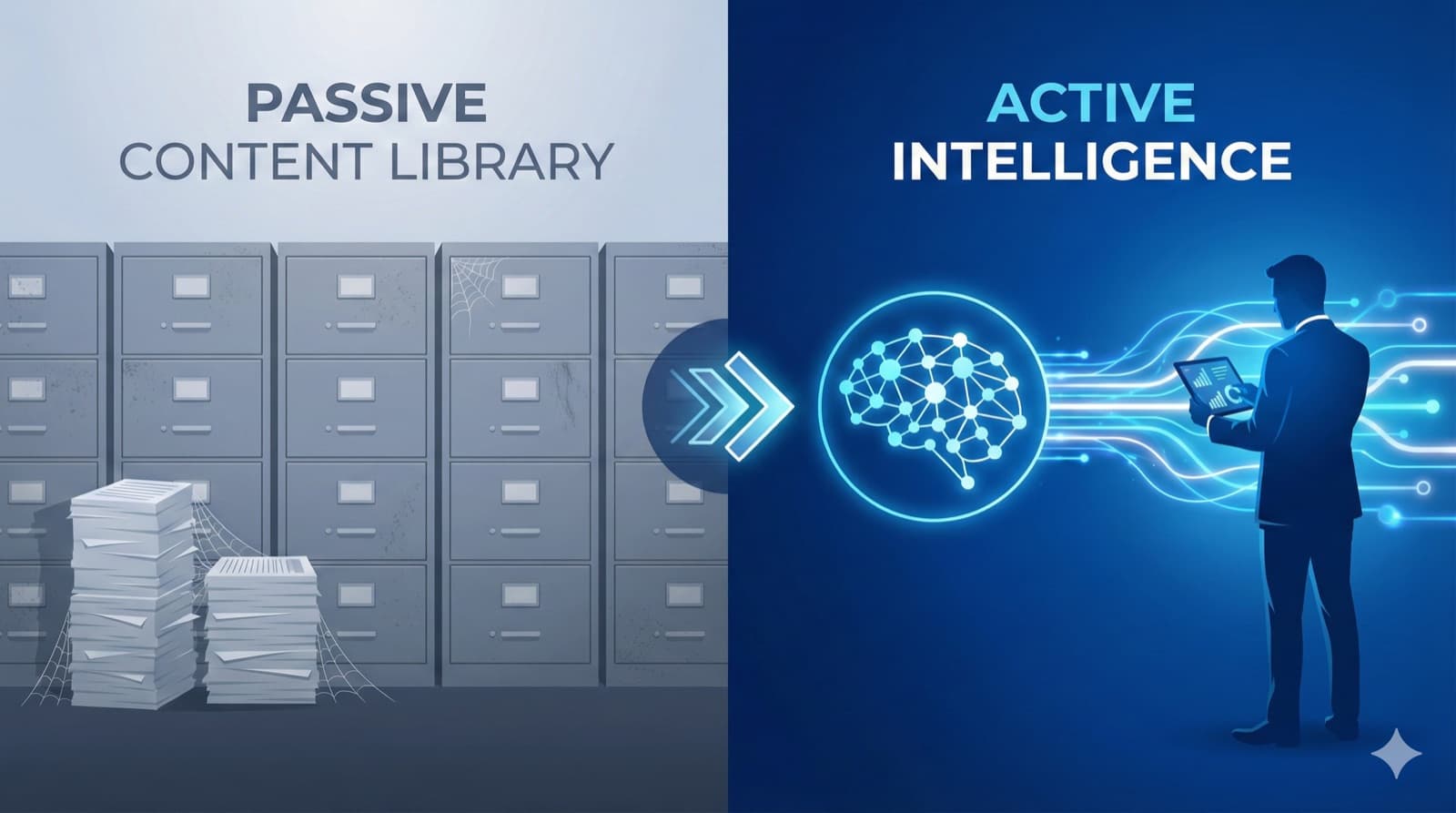
The Shift From Passive to Active
The transition from traditional Sales Enablement to GTM Intelligence isn't about replacing your entire stack. It's about adding an action layer that connects your existing investments.
Curate instead of accumulate. Rather than adding more content to the repository, identify the ~100 most critical pieces and keep them current. Assign owners. Archive the rest.
Embed instead of document. Rather than training reps on methodology and hoping they remember, build the framework into deal stages. Prompt for missing information. Score deals against criteria.
Push instead of pull. Rather than expecting reps to search for what they need, surface relevant content based on deal context. Provide meeting prep automatically. Offer Q&A during calls.
This isn't about technology preference—it's about recognizing that the bottleneck isn't information availability. It's information accessibility at the moment of need.
Where We Stand
We're building RevWiser because we believe the gap between knowing and doing is where most sales organizations lose. Content exists but doesn't get used. Methodology gets trained but not applied. Context lives in reps' heads but isn't captured.
Connecting these elements into real-time guidance is what we mean by GTM Intelligence. Whether that term becomes the category name or something else does, the underlying shift feels inevitable: sales technology that actively helps reps execute, not just passively stores information for them to find.
The question for any sales leader isn't which category label is correct. It's whether your current tools help reps sell better in the moment—or just tell you what happened afterward.
RevWiser is a GTM Intelligence platform that connects knowledge, methodology, and deal context into actionable guidance. We're defining what this category means as we build it. Learn more at revwiser.com.
RevWiser Team
Content writer at RevWiser, focusing on go-to-market strategies and sales enablement.