The 30-60-90 Day Sales Onboarding Plan That Cuts Ramp Time by 50%

Your new AE started three weeks ago. They've sat through product training, done some call shadowing, and have access to your entire Confluence wiki. They're smart and motivated.
Ask them to run a discovery call next week and they'll panic. Three months from now, they'll still be asking colleagues basic questions that were "covered in onboarding."
This pattern repeats across almost every sales organization we've worked with. The question is: why do smart people with good training still take 6-9 months to become productive?
The answer isn't that onboarding programs cover the wrong content. It's that they front-load information and hope reps retain it, instead of building continuous reinforcement into the workflow.
The Problem With Information Dumps
Week 1 at most companies looks something like this:
- 4-8 hours of product training presentations
- 2-4 hours of sales methodology overview
- Stack of PDFs to "review when you have time"
- Access to a knowledge base with 10,000+ documents
- Shadow a few calls with random reps
The result is predictable: reps feel overwhelmed, forget most of what they "learned," and have no clear path from "I sat through training" to "I can run this meeting." They end up asking colleagues the same questions that were covered in onboarding—not because they're slow, but because information covered once in Week 1 doesn't stick when you need it in Week 6.
The missing link is application. Reps need to use information close to when they learn it, in situations that feel real. Most onboarding saves this for the end ("Week 4: Start making calls"), which means three weeks of learning followed by one week of realizing you don't remember what you learned.
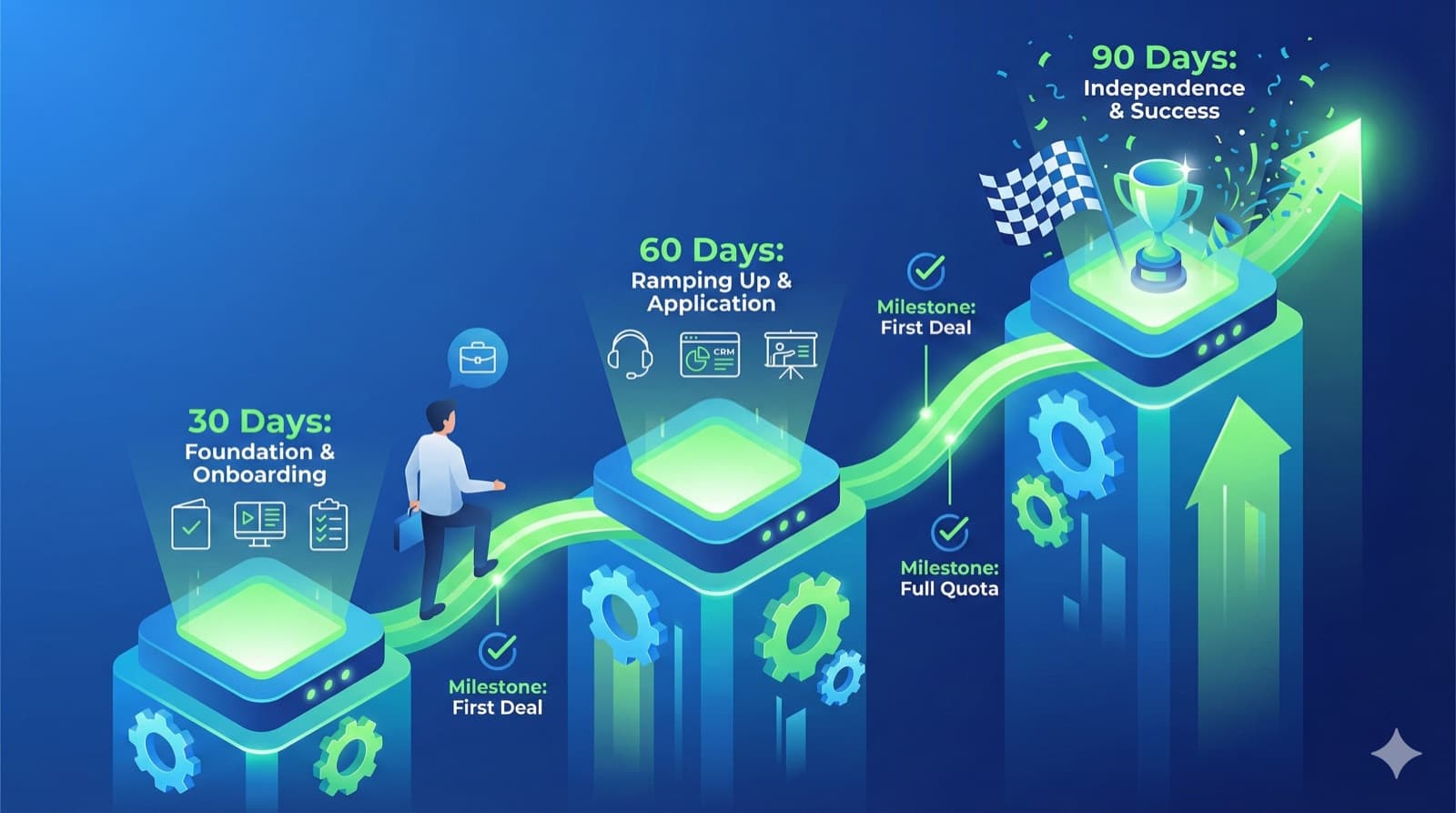
The 30-60-90 Framework Overview
| Phase | Focus | Outcome |
|---|---|---|
| Days 1-30 | Foundation | Rep understands product, customer, and process |
| Days 31-60 | Application | Rep executes with guidance and feedback |
| Days 61-90 | Independence | Rep operates autonomously with coaching support |
Each phase builds on the previous one, with continuous reinforcement replacing one-time training.
Phase 1: Foundation (Days 1-30)
Goal: Build the knowledge base that reps will draw from in every customer interaction.
Week 1: Orientation & Product Fundamentals
Day 1-2: Company & Culture
- Company mission, vision, and values
- Team introductions and org structure
- Tools setup (CRM, email, calendar, communication)
- 1:1 with manager to set expectations
Day 3-5: Product Deep Dive
- Product demo (as a customer would experience)
- Core features and use cases
- Technical architecture (high-level)
- Competitive landscape overview
Key Deliverable: Rep can give a 2-minute product overview without notes.
Week 2: Customer & Market
Understanding the Buyer:
- Ideal Customer Profile (ICP) deep dive
- Buyer personas and their priorities
- Common pain points by role
- Typical buying process and timeline
Understanding the Market:
- Industry trends and drivers
- Competitive positioning
- Common objections and responses
- Case study review (3-5 key customers)
Key Deliverable: Rep can articulate why a specific persona would buy and what objections they'd raise.
Week 3: Sales Process & Methodology
Your Sales Motion:
- Sales stages and exit criteria
- Qualification framework (MEDDIC, BANT, etc.)
- Discovery question framework
- Demo structure and best practices
Methodology Application:
- Role-play: Discovery call with manager
- Role-play: Product demo with SE
- Shadow 5+ customer calls with notes
- Debrief each shadowed call
Key Deliverable: Rep can run a mock discovery call that hits all qualification criteria.
Week 4: Tools & Systems
CRM Mastery:
- Opportunity management workflow
- Activity logging standards
- Pipeline and forecast expectations
- Reporting and dashboards
Enablement Tools:
- Content library orientation
- Meeting prep process
- Proposal and quote generation
- Email and outreach templates
Key Deliverable: Rep can create an opportunity, log activities, and find relevant content independently.
Phase 1 Success Metrics
| Metric | Target |
|---|---|
| Product knowledge quiz | 85%+ score |
| Mock discovery call rating | 3/5+ from manager |
| CRM proficiency check | Complete all required fields |
| Shadowed calls | 10+ with documented learnings |
Phase 2: Application (Days 31-60)
Goal: Move from observation to execution with guardrails and feedback loops.
Week 5-6: Guided Execution
First Live Calls:
- Run 5 discovery calls (manager listening)
- Debrief each call within 24 hours
- Identify 2-3 improvement areas per call
- Update personal development plan
Supported Selling:
- Create first 3 opportunities independently
- Build pipeline to 2x quota coverage target
- Conduct first product demos (with SE support)
- Handle first objections with talk track support
Key Deliverable: Rep has 3+ qualified opportunities in pipeline with accurate MEDDIC data.
Week 7-8: Increasing Independence
Expanded Responsibility:
- Run calls without manager listening (recorded for review)
- Conduct demos with less SE involvement
- Manage 5+ opportunities through sales stages
- First proposal submission
Continuous Learning:
- Weekly 1:1s with specific call review
- Peer learning: shadow top performer
- Identify and document tribal knowledge gaps
- Access real-time guidance tools
Key Deliverable: Rep advances 2+ opportunities to next stage independently.
Phase 2 Coaching Focus
| Area | Coaching Approach |
|---|---|
| Discovery | Review call recordings for question quality |
| Qualification | Audit MEDDIC completeness in CRM |
| Demo Skills | Observe and provide real-time feedback |
| Objection Handling | Role-play common objections weekly |
Phase 2 Success Metrics
| Metric | Target |
|---|---|
| Qualified pipeline | 2x monthly quota |
| Calls per week | 15+ discovery/demo calls |
| MEDDIC completion | 80%+ fields populated |
| Opportunity advancement | 3+ moved to next stage |
Phase 3: Independence (Days 61-90)
Goal: Rep operates autonomously with coaching for optimization, not survival.
Week 9-10: Full Pipeline Ownership
Independent Operation:
- Manage full pipeline without daily oversight
- Run entire sales cycle: prospect to close
- Coordinate cross-functional resources (SE, legal, etc.)
- Accurate forecasting of own opportunities
Advanced Skills:
- Multi-threading within accounts
- Executive engagement strategies
- Negotiation and pricing discussions
- Complex deal navigation
Key Deliverable: Rep closes first deal or has deal in final negotiation.
Week 11-12: Optimization & Graduation
Performance Optimization:
- Identify personal selling strengths and gaps
- Build repeatable prospecting rhythm
- Develop personal best practices
- Contribute to team knowledge sharing
Graduation Criteria:
- Full quota assignment (if not already)
- Transition to standard coaching cadence
- 90-day review and development plan
- Celebrate wins and learnings
Key Deliverable: Rep is operating at expected activity levels with clear path to quota attainment.
Phase 3 Success Metrics
| Metric | Target |
|---|---|
| Pipeline coverage | 3x quota |
| Forecast accuracy | Within 20% of actual |
| First closed deal | Yes (or advanced to negotiation) |
| Activity consistency | Meeting weekly standards |
The Continuous Reinforcement Model
The traditional model front-loads information and hopes it sticks. The continuous reinforcement model distributes learning throughout the 90 days and beyond.
What Continuous Reinforcement Looks Like
Instead of: 8-hour product training in Week 1
Try:
- 2-hour overview in Week 1
- Daily 15-minute product deep-dives in Weeks 2-4
- Product Q&A sessions before each demo
- Real-time product answers during calls
Instead of: MEDDIC training session with quiz
Try:
- MEDDIC overview in Week 3
- MEDDIC prompts during every discovery call
- Weekly MEDDIC audits with feedback
- Automatic MEDDIC scoring on all opportunities
Instead of: "Here's the knowledge base, search when you need something"
Try:
- Curated content delivered before each meeting
- Instant answers during live calls
- Relevant case studies pushed based on deal context
- Proactive objection handling suggestions
Tools That Enable Continuous Reinforcement
Modern GTM Intelligence platforms like RevWiser can automate continuous reinforcement by:
- Auto-generating meeting prep tailored to each opportunity
- Providing live Q&A during customer calls
- Prompting methodology questions in real-time
- Scoring deals against qualification criteria automatically
This shifts onboarding from "learn everything upfront" to "learn what you need when you need it."
Common Onboarding Mistakes to Avoid
Mistake 1: Information Overload in Week 1
The problem: Cramming everything into orientation week The fix: Spread foundational learning across 30 days with immediate application
Mistake 2: No Clear Milestones
The problem: "Ramp" is vague with no defined success criteria The fix: Specific, measurable deliverables for each week
Mistake 3: Sink-or-Swim After Training
The problem: Abrupt transition from "training" to "selling" The fix: Graduated responsibility with continued support
Mistake 4: Generic Content for Everyone
The problem: Same onboarding regardless of experience level The fix: Adjust pace and depth based on background (AE vs. SDR, industry experience, etc.)
Mistake 5: No Feedback Loop
The problem: Manager doesn't know what new hire struggles with The fix: Regular check-ins, call reviews, and skill assessments
Adapting the Template for Your Organization
This template is a starting point. Customize based on:
Sales Complexity
| Complexity | Adjustment |
|---|---|
| Transactional (SMB) | Compress to 60 days; more call volume earlier |
| Mid-Market | Standard 90-day template works well |
| Enterprise | Extend to 120-180 days; more strategic selling skills |
Product Complexity
| Complexity | Adjustment |
|---|---|
| Simple product | Less product training, more selling skills |
| Technical product | More SE involvement; deeper technical foundation |
| Platform/multi-product | Phased product learning; start with core offering |
New Hire Background
| Background | Adjustment |
|---|---|
| Industry experience | Less market education; more product focus |
| Sales experience, new industry | Balance product and market learning |
| New to sales | More foundational selling skills; slower ramp |
Measuring Onboarding Success
Leading Indicators (Track Weekly)
- Knowledge assessment scores
- Activity levels (calls, meetings, emails)
- Pipeline creation rate
- Methodology compliance (MEDDIC completion)
- Manager confidence rating
Lagging Indicators (Track Monthly)
- Time to first qualified opportunity
- Time to first closed deal
- Ramp to quota attainment percentage
- 90-day retention rate
- Performance vs. peers at same tenure
The Ultimate Metric
Your onboarding is successful when: A rep hired today performs like a rep hired 6 months ago—within their first 90 days, not their first 9 months.
Putting It Into Action
This Week
- Audit your current onboarding program against this template
- Identify the biggest gaps (likely: application, reinforcement, milestones)
- Pick one phase to redesign first
This Month
- Build out detailed 30-60-90 day plan with deliverables
- Create assessment criteria for each phase
- Train managers on coaching new hires through the phases
This Quarter
- Implement with next new hire cohort
- Measure leading indicators weekly
- Iterate based on feedback and results
What Actually Changes
We want to be realistic about what's achievable. "Cut ramp time by 50%" is a headline, and actual results vary by company, role complexity, and how well you execute.
What we can say: the companies we've seen with faster ramp times aren't doing more training—they're doing less front-loaded training and more continuous reinforcement. They've figured out that the problem isn't coverage (what you teach) but retention (what sticks when reps need it).
The 30-60-90 structure matters, but what matters more is building ongoing support into the system. If your new rep has to remember everything from training to do their job, they'll struggle. If they have access to the right information at the right moment—meeting prep that surfaces relevant case studies, Q&A during calls, methodology reminders tied to specific deals—they perform better faster.
Technology can help with this, including tools like ours. But the principle applies regardless of tools: design onboarding for how memory actually works, not how you wish it worked.
RevWiser accelerates onboarding by giving new reps access to product knowledge, methodology guidance, and deal context in the flow of work—not just in training sessions. If ramp time is costing you, see how it works.
RevWiser Team
Content writer at RevWiser, focusing on go-to-market strategies and sales enablement.