Stop Searching, Start Selling: Why GTM Teams Need an 'Anti-Knowledge Base'

Watch what happens when a rep needs a case study for an enterprise fintech deal:
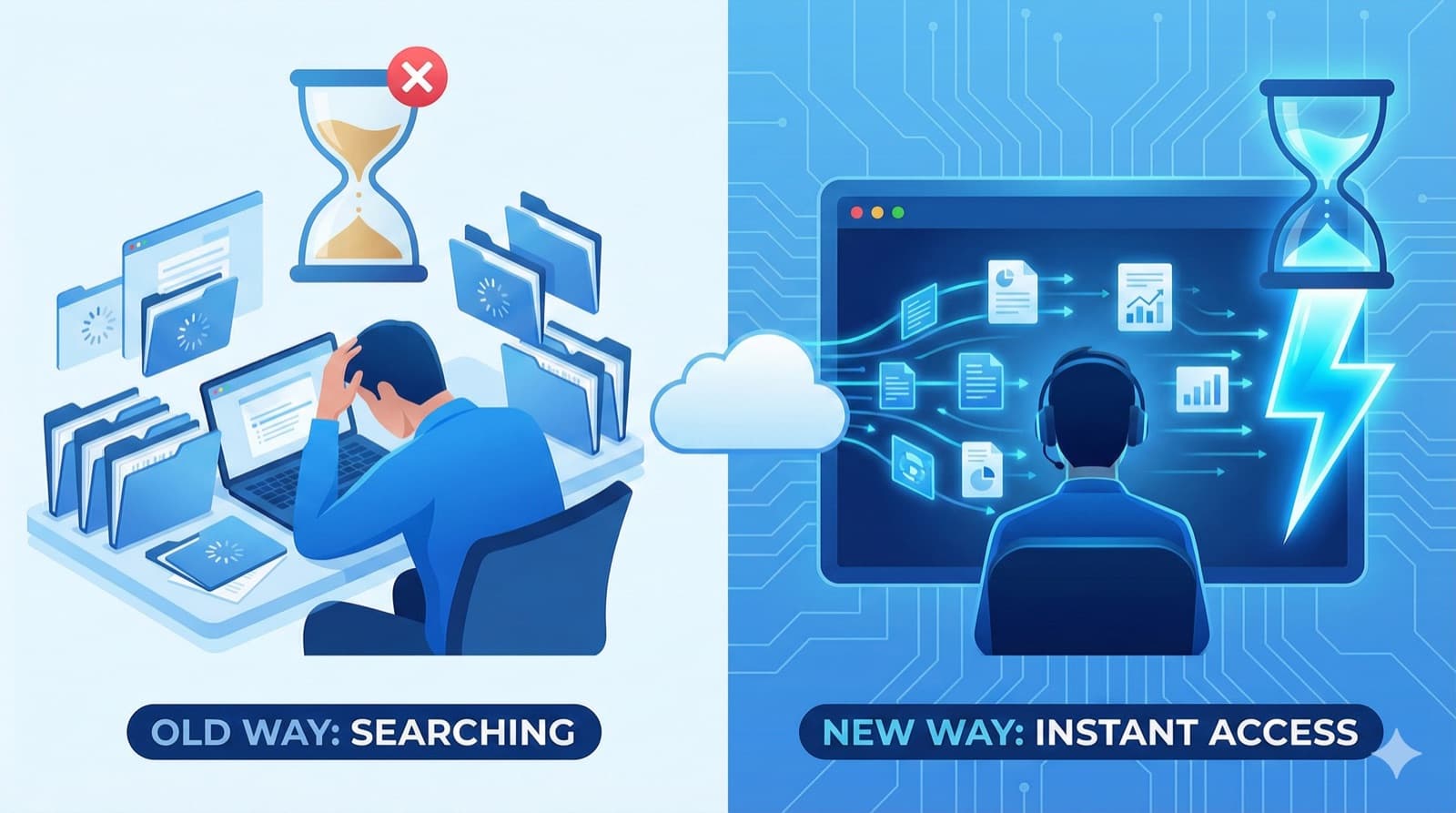
They search the wiki. Get 23 results. Open a few. One is clearly outdated (references features from two years ago). Two look similar but have different stats—which is current? Another is labeled "draft." They spend ten minutes clicking around, eventually ask in Slack, and someone shares a Google Doc that isn't in the wiki at all.
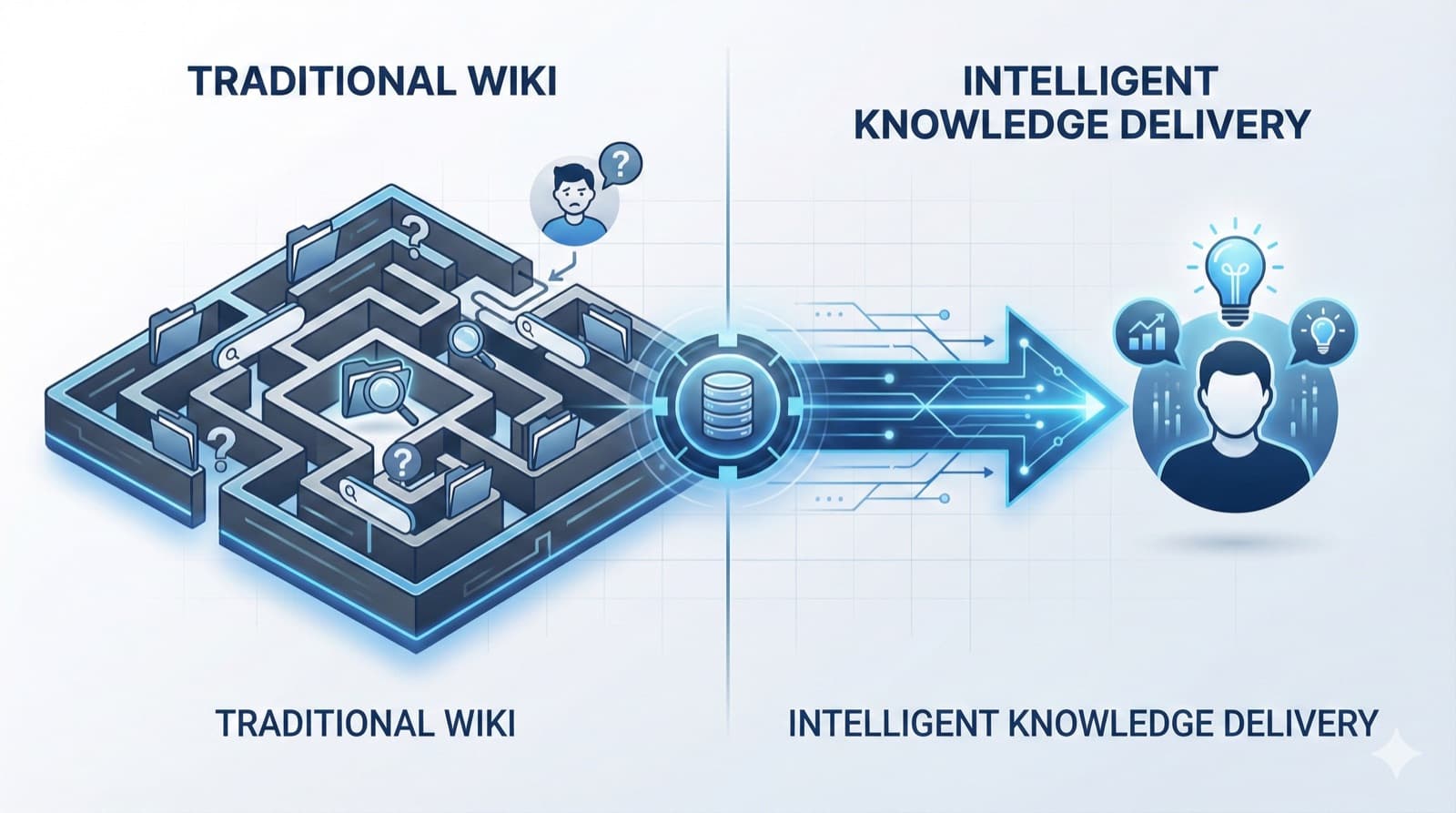
This isn't a search problem. Better search won't fix it. This is a fundamental mismatch between how knowledge bases work (you search, you find, you decide what's relevant) and how sales teams actually need information (right content, right context, right now).
We call the alternative an "anti-knowledge base"—not because we're against knowledge, but because the approach inverts the traditional model.
The Real Problem
Industry research consistently finds that sales content is underutilized. The exact numbers vary by study (the commonly cited "440 hours per year" and "80% of content goes unused" statistics are hard to verify precisely), but the pattern is clear: organizations create lots of content that reps don't access.
The quality issues are even more consistent:
- Multiple versions of the same document exist
- Nobody knows which is current
- Content accumulates faster than it gets updated
- New content gets created because nobody can find the existing version
Knowledge bases were designed for reference documentation—things you look up occasionally with time to evaluate results. Sales requires something different: the right information surfaced in context, often during a conversation when there's no time to search.
Why Traditional Knowledge Bases Fail GTM Teams
The knowledge base model was designed for reference documentation—technical manuals, HR policies, product specifications. It assumes the user knows what they're looking for and has time to find it.
That's the opposite of sales.
Problem 1: The Search Assumption
Traditional knowledge bases require you to:
- Know you need information
- Know what information exists
- Know how to find it
- Have time to search
- Evaluate results and select the right one
In a live sales call: A customer asks about integration with System X. The rep needs the answer in seconds, not minutes. They can't pause the call to search Confluence.
What actually happens: The rep says "let me get back to you on that"—and the momentum dies.
Problem 2: The Organization Paradox
Content can be organized by:
- Team (Marketing, Product, Sales)
- Topic (Product, Pricing, Competition)
- Use case (Objections, Case Studies, Technical)
- Customer segment (Enterprise, SMB, Industry)
But users need content across all these dimensions simultaneously. A rep needs:
- The pricing objection response (topic)
- For enterprise fintech customers (segment)
- From last quarter (time)
- That Sarah used successfully (social proof)
No folder structure can handle this. So reps give up and ask a colleague.
Problem 3: The Maintenance Fantasy
Knowledge bases assume:
- Content will be kept current
- Old versions will be archived
- Someone will maintain organization
- Users will report issues
Reality:
- Content creators move on to new projects
- No one owns maintenance
- Organization breaks down over time
- Users work around problems instead of fixing them
Problem 4: The Context Gap
A knowledge base provides content. It doesn't provide context:
- When should I use this?
- Who is this for?
- What's changed since last version?
- How does this relate to what I'm working on?
Reps have to figure out relevance on their own—if they can find the content at all.
Problem 5: The Volume Trap
Organizations think: "If we just had more content, we'd be better enabled."
So they create more:
- Every webinar becomes a deck
- Every product release gets documentation
- Every customer becomes a case study
- Every objection gets a response
Result: 10,000+ pieces of content. Reps can't find any of them. Volume has made the problem worse, not better.
The Anti-Knowledge Base Concept
An anti-knowledge base inverts the traditional model:
| Traditional Knowledge Base | Anti-Knowledge Base |
|---|---|
| User searches for content | System delivers content |
| Organized by structure | Organized by context |
| All content available | Only relevant content surfaces |
| User evaluates options | System recommends best option |
| Static repository | Dynamic, context-aware |
| Quantity over quality | Curated, maintained content |
Core Principles
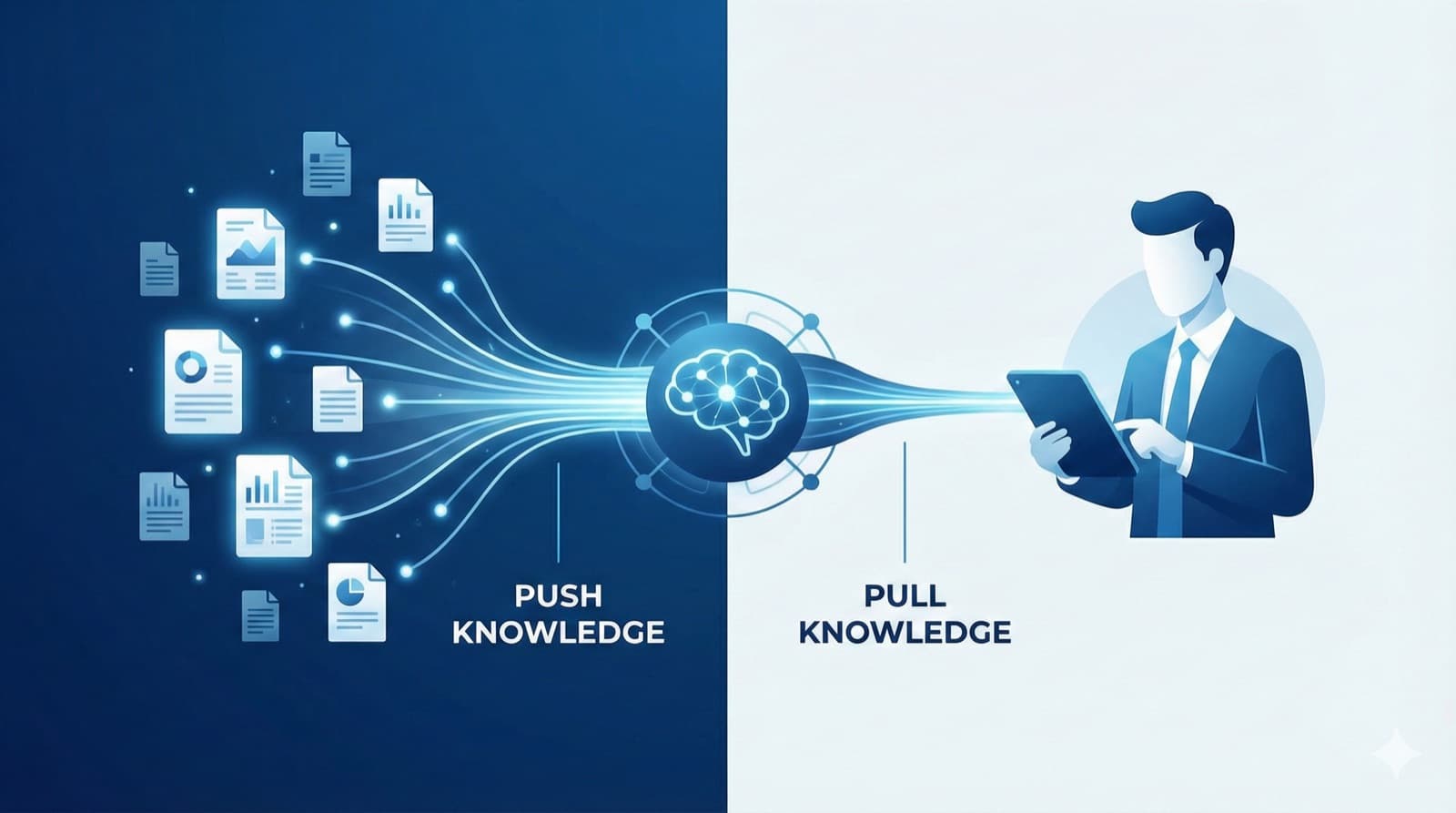
1. Push, Don't Pull
Instead of reps searching for what they need, the system delivers it based on what they're doing:
- About to meet with a fintech CFO? Here's the ROI case study that resonates.
- Competitor X mentioned in the call? Here's the positioning.
- Pricing objection raised? Here's the response that works.
2. Context Over Structure
Content is organized by when and how it's used, not by who created it:
- Deal stage
- Customer persona
- Competitive situation
- Objection type
- Use case
3. Curated Over Accumulated
Less is more:
- ~100 pieces of core content, expertly maintained
- Clear ownership and update cadence
- Retired content actively removed
- Quality over quantity
4. Living, Not Static
Content evolves based on:
- What reps actually use
- What wins deals
- What customers respond to
- Market and competitive changes
What an Anti-Knowledge Base Looks Like
For Pre-Call Preparation
Traditional: Rep searches "fintech case study," gets 23 results, spends 15 minutes finding the right one, isn't sure if it's current.
Anti-knowledge base: Rep opens meeting prep for Acme Corp. System surfaces: "For fintech compliance buyers, your most effective case study is First National (updated last month). They saw 40% reduction in audit prep time."
For Live Call Support
Traditional: Customer asks about integration with Legacy System. Rep says "let me get back to you" because they can't search mid-call.
Anti-knowledge base: Rep asks their AI assistant: "What's our integration story for Legacy System?" Gets instant answer: "We have a native connector that syncs bidirectionally. Here's the architecture diagram. Typical implementation is 2-3 weeks."
For Objection Handling
Traditional: Rep faces "you're too expensive" objection. Wings a response or tries to remember training from 6 months ago.
Anti-knowledge base: During call, system surfaces: "For price objections, top closers lead with TCO comparison. Here's the calculator and talk track." Rep has ammunition in real-time.
For Competitive Situations
Traditional: Rep learns competitor is involved. Searches for battlecard. Finds outdated version. Doesn't trust it.
Anti-knowledge base: Deal marked as competitive with Competitor X. System automatically surfaces: "Current positioning vs. X (updated this week). They typically claim faster implementation—counter with these two customer stories where we deployed faster."
Building Your Anti-Knowledge Base
Ready to make the shift? Here's the roadmap:
Step 1: Audit Your Content
Before building, understand what you have:
Content inventory:
- How many pieces of content exist?
- Where do they live? (How many systems?)
- When were they last updated?
- Who owns each piece?
Usage analysis:
- What do reps actually access?
- What gets shared in deals?
- What do reps ask for that doesn't exist?
- What gets recreated because it can't be found?
Gap analysis:
- What content wins deals?
- What content is missing?
- What content exists but is outdated?
- What content exists but never gets used?
Step 2: Curate the Core 100
Not all content is equal. Identify your essential content:
Product Knowledge (15-20 pieces):
- Core positioning and value props
- Key features and use cases
- Technical architecture
- Integration capabilities
Customer Proof (15-20 pieces):
- Top case studies by segment
- ROI metrics and benchmarks
- Reference customers and quotes
- Success story templates
Competitive Intelligence (5-10 pieces):
- Head-to-head positioning
- Win/loss analysis
- Counter-messaging
- Competitive landmines
Sales Process (10-15 pieces):
- Qualification criteria
- Discovery questions by stage
- Objection handling scripts
- Pricing and negotiation guides
Personas and Segments (5-10 pieces):
- ICP definitions
- Buyer persona profiles
- Industry-specific messaging
- Use case templates
Total: ~100 pieces that are expertly maintained vs. 10,000 pieces that are mostly ignored.
Step 3: Assign Ownership
Every piece of content needs:
A single owner:
- Responsible for accuracy
- Accountable for updates
- Empowered to make changes
- Named, not a team
An update cadence:
- Pricing: Monthly
- Competitive: Monthly
- Case studies: Quarterly
- Product features: With releases
A retirement policy:
- What triggers archival?
- How long before outdated content is removed?
- Who makes the call?
Step 4: Enable Contextual Delivery
Connect content to context:
Deal stage triggers:
- Early stage → Discovery questions, qualification criteria
- Mid stage → Case studies, ROI tools, technical docs
- Late stage → Competitive positioning, pricing, negotiation
Persona triggers:
- Technical buyer → Architecture, integration, security
- Business buyer → ROI, case studies, value props
- Executive → Strategic vision, reference calls, exec summaries
Competitive triggers:
- Competitor mentioned → Battlecard, win stories, positioning
- Specific objection → Counter-messaging, evidence
Activity triggers:
- Pre-meeting → Relevant prep materials
- During call → Live Q&A support
- Post-meeting → Follow-up templates, next steps
Step 5: Measure and Iterate
Track what's working:
Usage metrics:
- What content is actually accessed?
- What's searched for but not found?
- What's delivered but ignored?
Outcome metrics:
- Does content usage correlate with wins?
- Which content drives deal progression?
- What gaps appear in lost deals?
Quality metrics:
- Is content current?
- Is ownership being maintained?
- Are reps satisfied with what they find?
The Transformation in Practice
Before: The Knowledge Base Struggle
- 10,000 documents across 5 systems
- Average search time: 8 minutes
- Most content over 6 months old
- Reps create their own "personal" content libraries
- "Where's the latest X?" is the #1 Slack question
After: The Anti-Knowledge Base Flow
- 100 curated pieces, expertly maintained
- Content surfaces automatically in context
- Weekly ownership reviews keep everything current
- Reps trust what they receive
- Searching becomes the exception, not the rule
The impact:
- Prep time: 45 minutes → 10 minutes
- Content confidence: 40% → 90%
- Time recovered per rep: 8+ hours per week
- "Where's the X?" questions: Down 80%
The Mindset Shift
Moving from knowledge base to anti-knowledge base requires a fundamental mindset shift:
From: "How do we store everything reps might need?" To: "How do we deliver exactly what reps need, when they need it?"
From: "Reps should search and find information" To: "Information should find reps at the right moment"
From: "More content is better" To: "Less content, expertly maintained, is better"
From: "Build it and they will come" To: "Deliver it where they already work"
The Tradeoffs
We should be honest about what you give up with this approach:
Less flexibility. A wiki can hold anything. A purpose-built system is more opinionated about what content exists and how it's organized.
More maintenance upfront. Curating to 100 pieces takes work. Assigning owners takes work. The ongoing maintenance is actually less than an unmaintained wiki, but the initial investment is higher.
Technology dependency. If your content delivery depends on understanding deal context, you need integrations that work. If they break, you're back to searching.
Cost. Purpose-built GTM tools cost more than wikis. The ROI argument depends on believing productivity gains justify the expense.
That said, for teams where the wiki isn't working—reps don't use it, content isn't trusted, "where's the X?" is a daily question—the current approach has costs too. They're just less visible.
The Bottom Line
The traditional knowledge base model assumes reps will search for what they need. For sales teams, that assumption is often wrong. Reps are in calls, preparing for meetings, working deals. They don't have time to search and evaluate. They need the right content to arrive in context.
The anti-knowledge base inverts the model: system delivers, rep receives. Context determines relevance. Less content, better maintained. Push, not pull.
Whether you build this yourself, cobble together existing tools, or use a purpose-built platform like RevWiser, the principle is the same: stop making reps search and start delivering what they need when they need it.
RevWiser delivers the right content at the right moment—in meeting prep, during calls, throughout deals—without requiring search. If your knowledge base isn't working, see how we approach it differently.
RevWiser Team
Content writer at RevWiser, focusing on go-to-market strategies and sales enablement.